
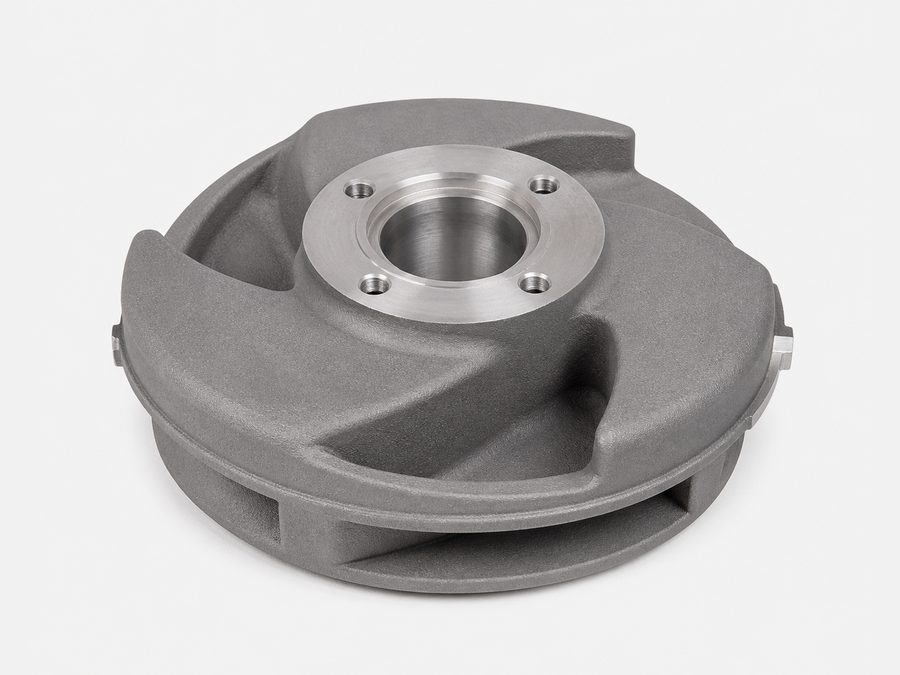
Slurry Impeller
Thick sections and few wide vanes — designed to wear out and be replaced.
A slurry impeller is not trying to be efficient. Fewer vanes means wider passages and less surface for abrasive to attack; thick sections mean there is material to lose before the geometry stops working.
It is a consumable, and it is quoted as one. The useful question is not how long it lasts but how quickly a replacement arrives — which is why we hold the tooling rather than re-making it for each order.
| Casting process | Vertical-line sand moulding on two lines (national patent) |
| Materials | Grey iron · ductile iron · WCB carbon steel · CF8M stainless |
| Machined features | Bore and keyway · hub face · vane tip diameter · balance correction |
| Minimum order | 100 pieces |
| Certification | EN 10204 3.1 per heat, spectrometer results |
| Source of geometry | Your drawing, 3D file or a worn sample |
What Is Difficult About This One
Every casting has one or two features that decide whether the batch repeats. On this part they are these.
Thick everywhere, so feeding is the job
Heavy sections shrink. Risers and their placement do more for this casting than anything else in the process.
Fewer vanes, larger fillets
Wide radii at the vane roots — the sharp corner that survives on a clean-water impeller is an erosion site here.
Hardness follows the alloy
Within the four alloys we run, the harder options wear better and machine worse. Which one is right is a duty question, and we will say what we think.
Alloy Options
The same geometry is a different part in three different plants. Chloride content, abrasion and temperature drive the choice — not the name of the fluid.
| Alloy | Grade | When it is the right choice |
|---|---|---|
| Grey iron | HT200 / HT250 | Default for water duty. Damps vibration, machines easily, lowest cost. |
| Ductile iron | QT450 / QT500 | When the duty is cyclic or the part takes shock. Tougher than grey. |
| WCB carbon steel | ASTM A216 WCB | Higher strength, weldable. For pressure-bearing bodies. |
| CF8M stainless | ASTM A743 CF8M | Chloride and corrosion duty — the cast equivalent of 316. |
What to Send Us
These are the ones specific to this part. A drawing, a 3D file or the worn original covers all of them at once.
| Item | Why it matters |
|---|---|
| What is in the slurry | Particle size, hardness and concentration — all three |
| Current impeller life | What you are getting now, and what you need |
| Shaft diameter and key size | Bore and keyway |
Others in Impellers
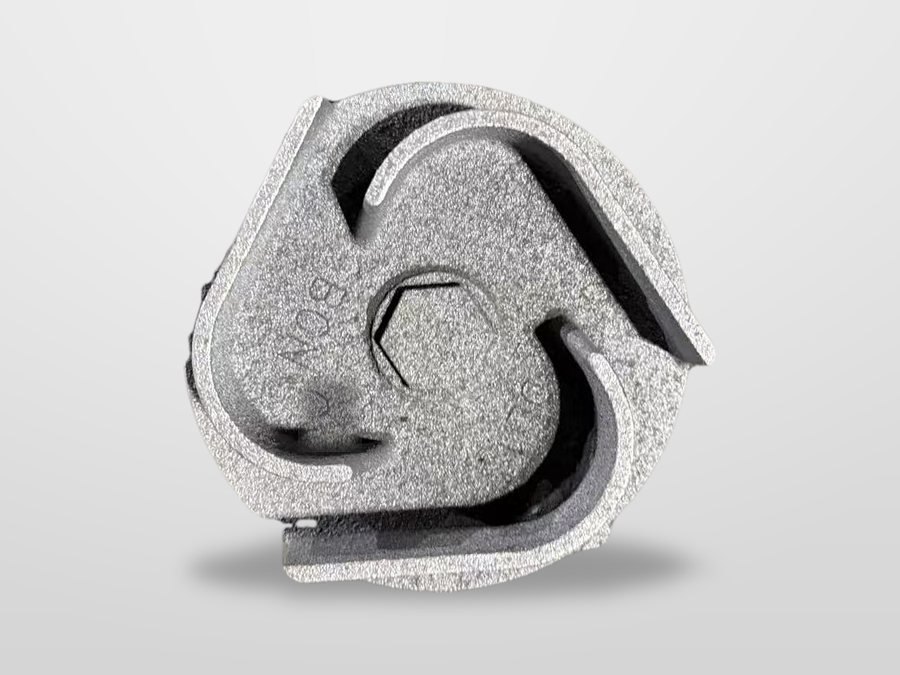
Semi-Open Impeller
Back shroud only. The vanes run open against the casing face.
View ›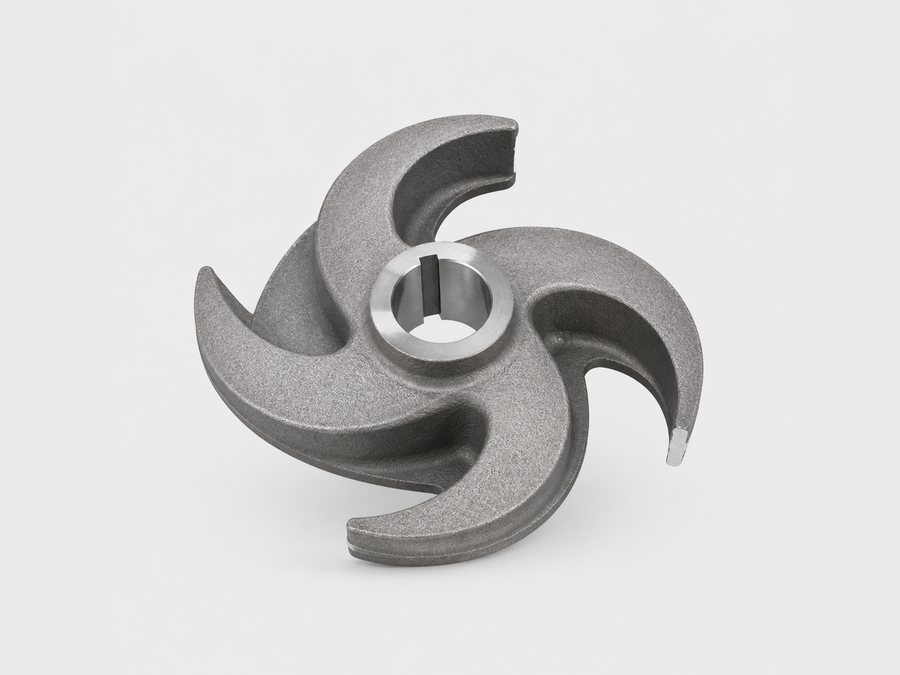
Open Impeller
No shroud at all — vanes on a hub, clear through from both sides.
View ›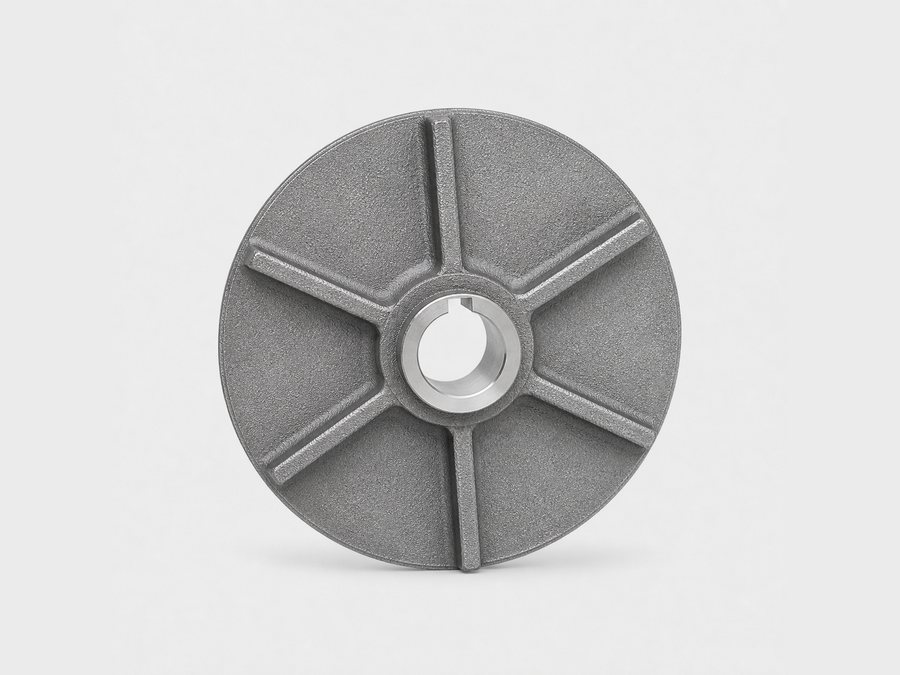
Vortex Impeller
Recessed into the casing. Solids pass through on the vortex without touching it.
View ›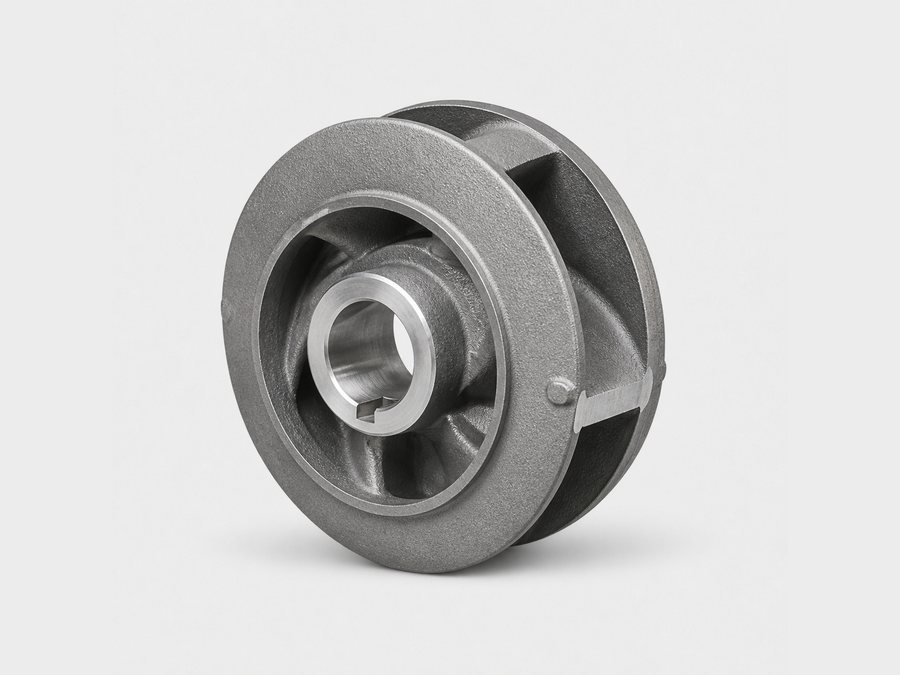
Double-Suction Impeller
Flow enters from both sides, so the axial thrust largely cancels itself.
View ›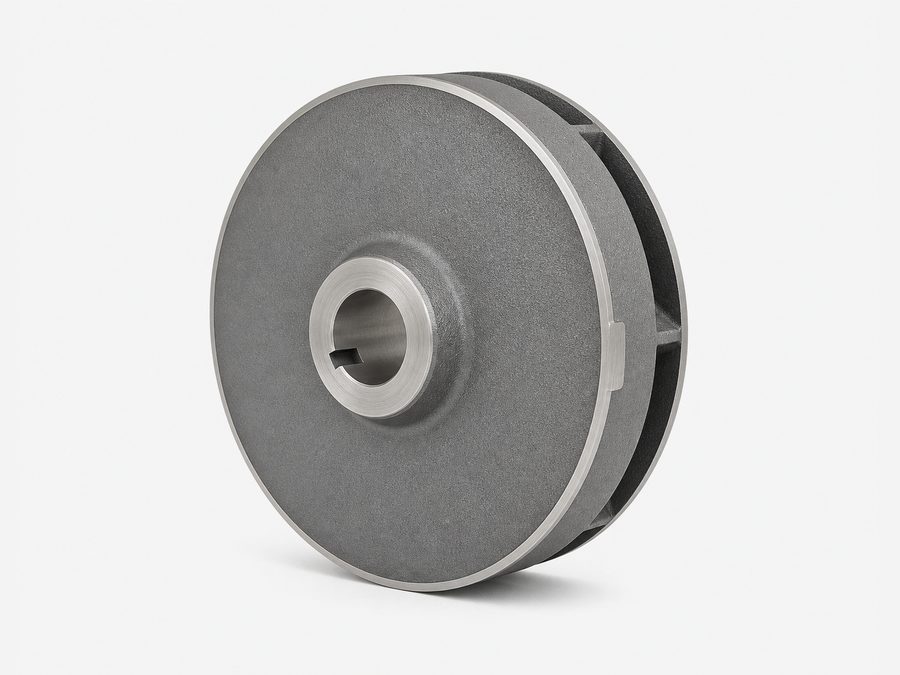
CF8M Stainless Impeller
Cast 316 equivalent, for chloride and chemical duty
View ›
Closed Impeller
205 × 205 × 52.5 mm · 3D model
View ›