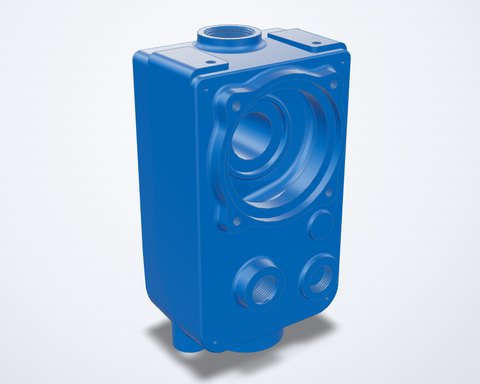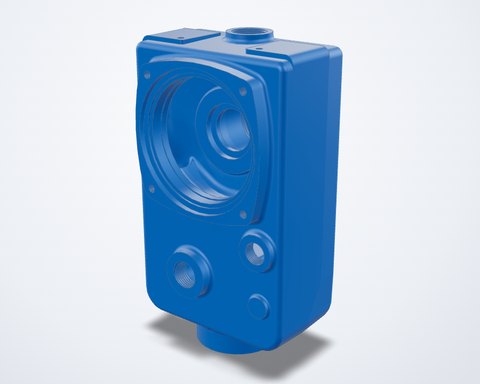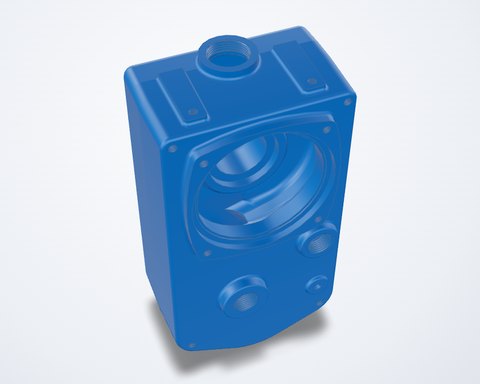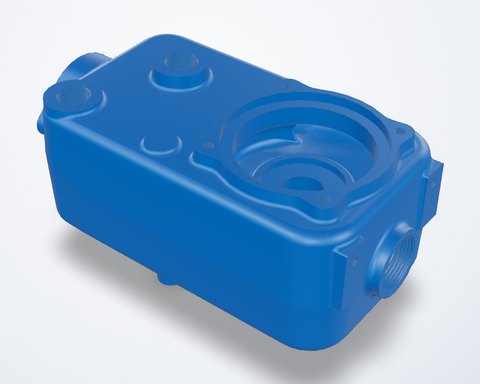
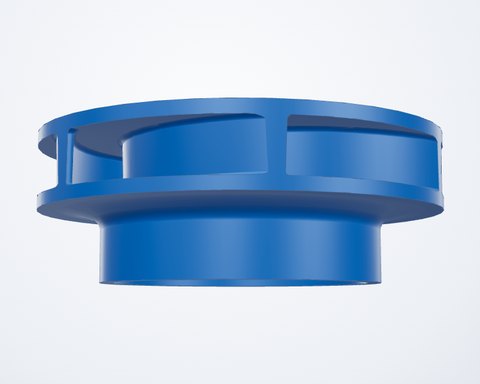
Closed Impeller
Both shrouds closed over the vanes, a keyed bore at the hub, and the vane profile cast rather than cut.
A closed impeller is the highest-efficiency construction and the hardest of the three to cast, because the passage between the shrouds is completely enclosed. The core that forms it has to be supported only at the vanes and the eye, and it has to come out afterwards — there is no access to break it up from outside.
Ø205 × 52.5 mm, about 1.1 kg in grey iron. It is a rotating part, so it leaves here dynamically balanced to ISO 1940 with the grade stated on the report, alongside the material certificate.
| Envelope | 205 × 205 × 52.5 mm |
| Cast volume | 148.8 cm³ |
| Weight, grey iron | approx. 1.07 kg as-cast |
| Casting process | Vertical-line sand moulding on two lines (national patent) |
| Materials | Grey iron · ductile iron · WCB carbon steel · CF8M stainless |
| Machined features | Bore and keyway · hub faces · shroud outside diameter · balance correction |
| Minimum order | 100 pieces |
| Certification | EN 10204 3.1 per heat, spectrometer results |
| Source of geometry | Your drawing, 3D file or a worn sample |
What Is Difficult About This One
Every casting has one or two features that decide whether the batch repeats. On this part they are these.
Enclosed passage core
Supported at the vanes and the eye only, and it has to break out cleanly after shakeout. This is the part of the job that decides whether a closed impeller is any good.
Vane profile is cast, not machined
Reproducing the hydraulic profile is the whole job on an aftermarket impeller. We reconstruct it off the drawing or the worn part and say on the quotation which dimensions came from which.
Balanced before it ships
Dynamically balanced to ISO 1940. An impeller that is out of balance takes the bearings and the seal with it, so this is not optional.
Alloy Options
The same geometry is a different part in three different plants. Chloride content, abrasion and temperature drive the choice — not the name of the fluid.
| Alloy | Grade | When it is the right choice |
|---|---|---|
| Grey iron | HT200 / HT250 | Default for water duty. Damps vibration, machines easily, lowest cost. |
| Ductile iron | QT450 / QT500 | When the duty is cyclic or the part takes shock. Tougher than grey. |
| WCB carbon steel | ASTM A216 WCB | Higher strength, weldable. For pressure-bearing bodies. |
| CF8M stainless | ASTM A743 CF8M | Chloride and corrosion duty — the cast equivalent of 316. |
What to Send Us
These are the ones specific to this part. A drawing, a 3D file or the worn original covers all of them at once.
| Item | Why it matters |
|---|---|
| Shaft diameter and key size | Bore and keyway are the fit that has to be right |
| Vane count and outlet angle | Or send the worn impeller and we will measure it |
| Direction of rotation | Looking from the drive end — it is the question most often missed |
| Balance grade required | ISO 1940 G6.3 is standard; say if you need finer |
Related Castings
Other parts in the same range — all shown as 3D models you can turn.