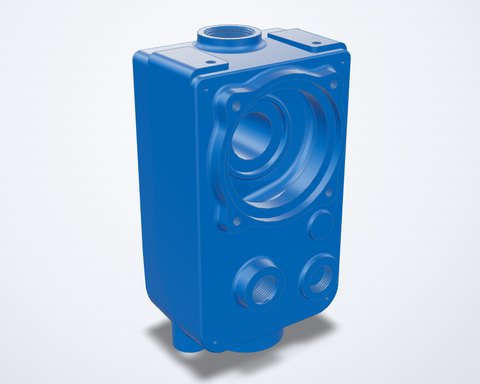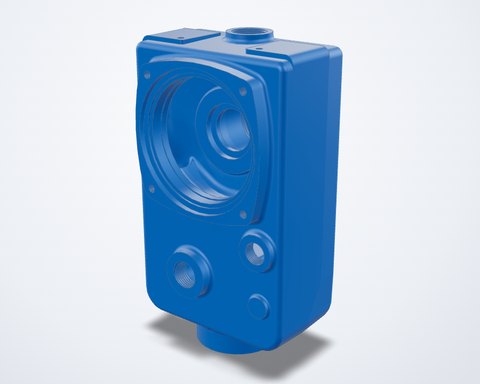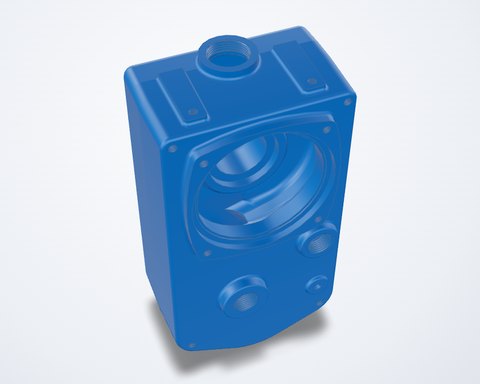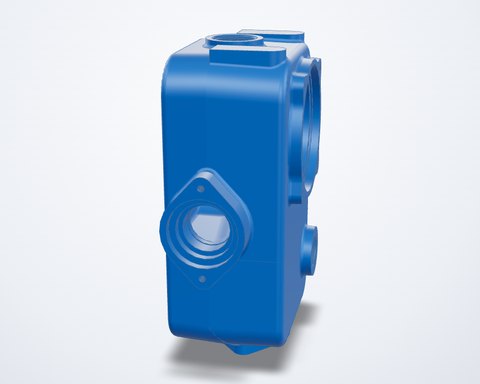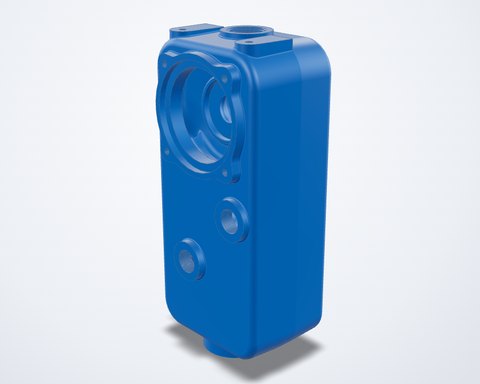
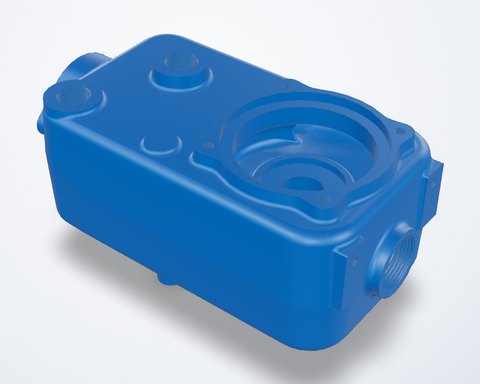
Elbow-Flange Pump Casing
A horizontal body with the elbow cast in rather than bolted on, and a machined flange face on the discharge side.
Casting the elbow into the body removes a joint. One less gasket, one less pair of faces to machine, and no flange bolts to come loose in service. The trade is a more awkward core — the passage turns inside the casting, so the core has to be supported at both ends and still strip cleanly.
It lies down rather than standing up: 128 × 184 × 100 mm, about 2.2 kg in grey iron. The top face carries the chamber and two cored ports; the flange and everything behind it come off in one draw.
| Envelope | 127.8 × 183.5 × 99.7 mm |
| Cast volume | 310.5 cm³ |
| Weight, grey iron | approx. 2.24 kg as-cast |
| Casting process | Vertical-line sand moulding on two lines (national patent) |
| Materials | Grey iron · ductile iron · WCB carbon steel · CF8M stainless |
| Machined features | Discharge flange face and bolt holes · chamber bore and register · top port threads |
| Minimum order | 100 pieces |
| Certification | EN 10204 3.1 per heat, spectrometer results |
| Source of geometry | Your drawing, 3D file or a worn sample |
What Is Difficult About This One
Every casting has one or two features that decide whether the batch repeats. On this part they are these.
The elbow passage is a supported core
It turns inside the casting, so it is printed at both ends. An unsupported core in a turn like this floats and you get an eccentric wall.
Flange face cast proud
It is skimmed after casting. Machining a face that was cast to size leaves you nothing to clean up if the mould moves.
Everything behind the flange stays as-cast
Only the faces that have to seal or locate get cut. The rest is as it comes out of the sand — which is what keeps the price where it is at 100 pieces.
Alloy Options
The same geometry is a different part in three different plants. Chloride content, abrasion and temperature drive the choice — not the name of the fluid.
| Alloy | Grade | When it is the right choice |
|---|---|---|
| Grey iron | HT200 / HT250 | Default for water duty. Damps vibration, machines easily, lowest cost. |
| Ductile iron | QT450 / QT500 | When the duty is cyclic or the part takes shock. Tougher than grey. |
| WCB carbon steel | ASTM A216 WCB | Higher strength, weldable. For pressure-bearing bodies. |
| CF8M stainless | ASTM A743 CF8M | Chloride and corrosion duty — the cast equivalent of 316. |
What to Send Us
These are the ones specific to this part. A drawing, a 3D file or the worn original covers all of them at once.
| Item | Why it matters |
|---|---|
| Flange standard | PN/ANSI rating and bolt pattern, or a drawing of the mating flange |
| Elbow angle and centreline | Where the passage has to come out relative to the foot |
| Port threads on the top face | Standard and depth |
Related Castings
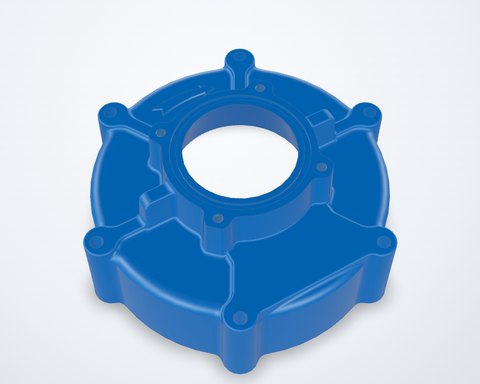
Other parts in the same range — all shown as 3D models you can turn.