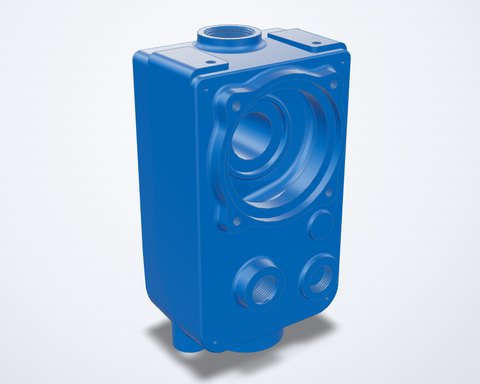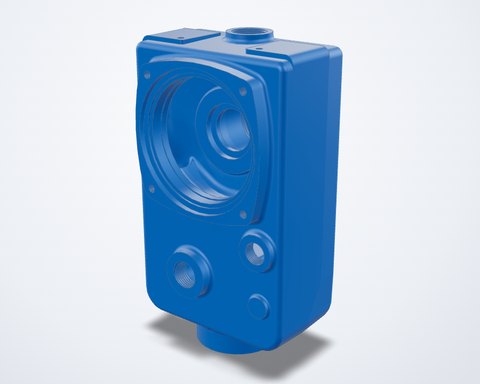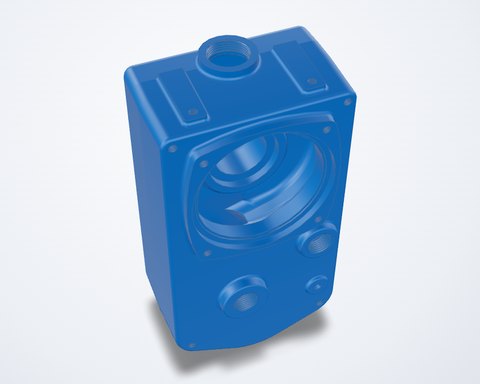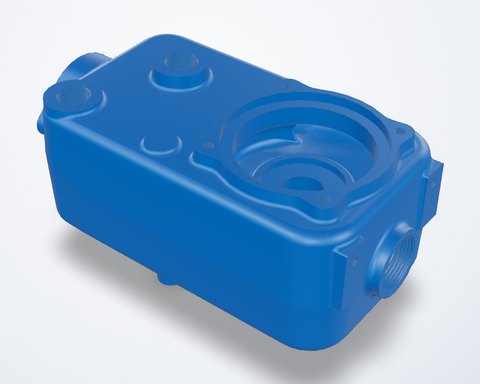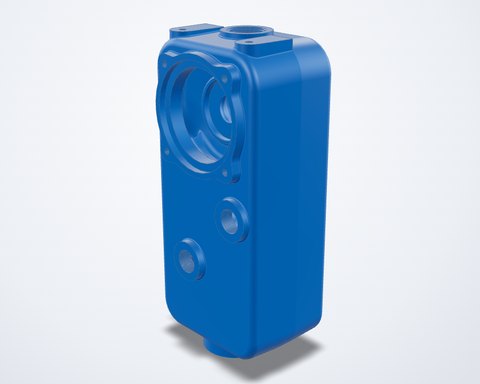
Side-Inlet Pump Casing
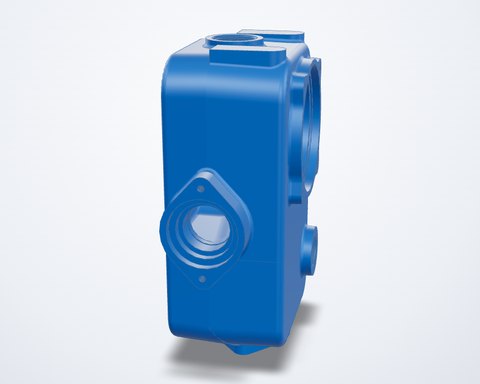
Suction comes in through a boss on the side of the body rather than through the end, which is what lets the pump sit tight against a wall or inside a fixed footprint.
The inlet boss is cored and then tapped, so the thread runs into cast metal rather than into a drilled hole in a thin wall. That matters here: the boss wall is one of the thinner sections in the part and a drilled-and-tapped thread would leave very little behind it.
Envelope is 148 × 95 × 194 mm, about 2.5 kg in grey iron. The front chamber and bolt circle are common with the rest of this family, so the covers interchange.
| Envelope | 148.3 × 95.4 × 193.7 mm |
| Cast volume | 349.8 cm³ |
| Weight, grey iron | approx. 2.52 kg as-cast |
| Casting process | Vertical-line sand moulding on two lines (national patent) |
| Materials | Grey iron · ductile iron · WCB carbon steel · CF8M stainless |
| Machined features | Inlet boss thread and face · chamber steps and bolt circle · foot underside |
| Minimum order | 100 pieces |
| Certification | EN 10204 3.1 per heat, spectrometer results |
| Source of geometry | Your drawing, 3D file or a worn sample |
What Is Difficult About This One
Every casting has one or two features that decide whether the batch repeats. On this part they are these.
Side boss on its own core print
It projects out of the main draw, so it is printed separately rather than being pulled as part of the body.
Thread runs into cast metal
The port is cored first. There is enough wall behind the thread because the wall was designed with the core in it, not drilled into afterwards.
Chamber shared with the end-suction bodies
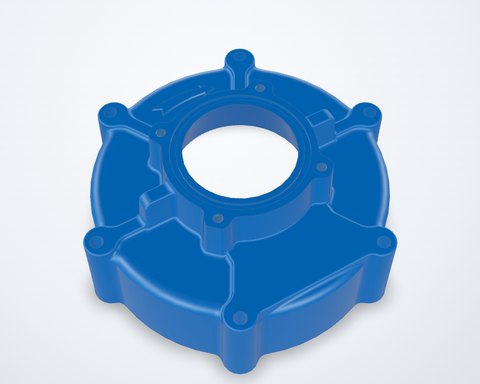
Same front face and bolt circle as the other casings in the range — one cover pattern serves several bodies.
Alloy Options
The same geometry is a different part in three different plants. Chloride content, abrasion and temperature drive the choice — not the name of the fluid.
| Alloy | Grade | When it is the right choice |
|---|---|---|
| Grey iron | HT200 / HT250 | Default for water duty. Damps vibration, machines easily, lowest cost. |
| Ductile iron | QT450 / QT500 | When the duty is cyclic or the part takes shock. Tougher than grey. |
| WCB carbon steel | ASTM A216 WCB | Higher strength, weldable. For pressure-bearing bodies. |
| CF8M stainless | ASTM A743 CF8M | Chloride and corrosion duty — the cast equivalent of 316. |
What to Send Us
These are the ones specific to this part. A drawing, a 3D file or the worn original covers all of them at once.
| Item | Why it matters |
|---|---|
| Inlet thread and its height off the foot | Both, together — the height is what usually clashes |
| Which side the inlet sits on | There is a left and a right; they are different patterns |
| Chamber bolt circle | To confirm your existing cover fits |
Related Castings
Other parts in the same range — all shown as 3D models you can turn.