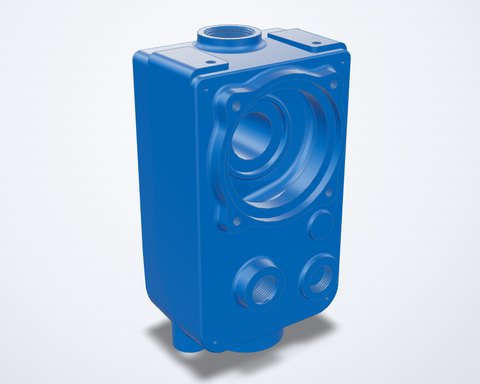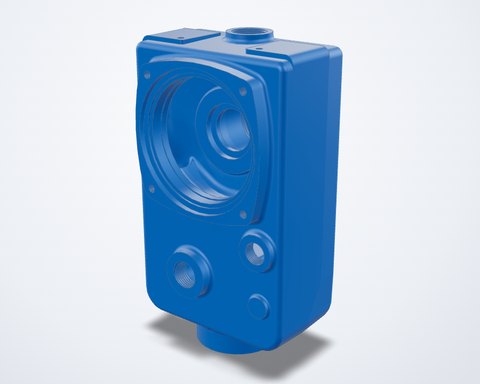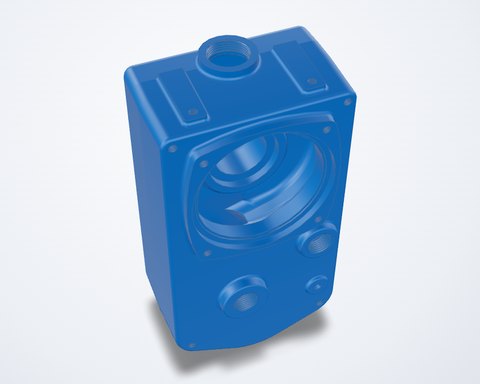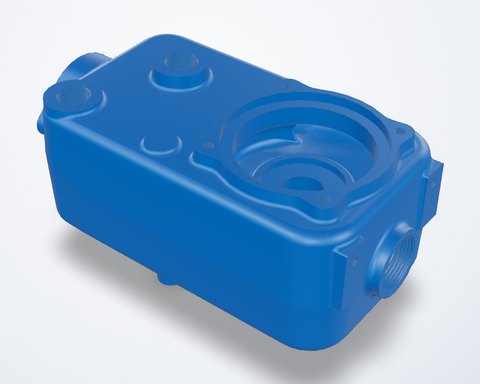
Split Retaining Ring
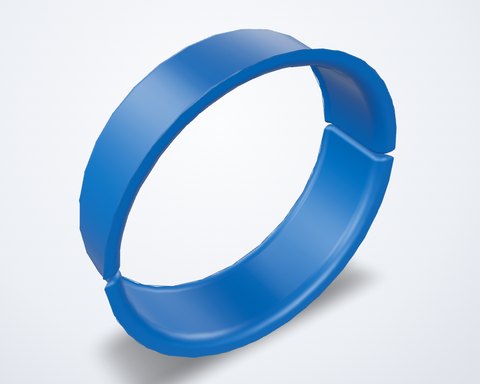
A small split ring with a retaining lip — Ø49 × 13.6 mm and about 10 grams.
Parts this size are the ones people assume should be turned from bar. At one-off that is true. At a few thousand it is not: bar stock means machining away most of the material and paying for the swarf, while the cast ring comes out at close to finished shape with only the lip and the bore to clean up.
The split is cast in, not sawn afterwards. A sawn split takes a kerf out of the circumference and changes the free diameter; a cast split does not.
| Envelope | 48.9 × 13.6 × 48.7 mm |
| Cast volume | 1.6 cm³ |
| Weight, grey iron | approx. 0.01 kg as-cast |
| Casting process | Vertical-line sand moulding on two lines (national patent) |
| Materials | Grey iron · ductile iron · WCB carbon steel · CF8M stainless |
| Machined features | Lip face · bore · gap faces if they seat |
| Minimum order | 100 pieces |
| Certification | EN 10204 3.1 per heat, spectrometer results |
| Source of geometry | Your drawing, 3D file or a worn sample |
What Is Difficult About This One
Every casting has one or two features that decide whether the batch repeats. On this part they are these.
Cast to near-net shape
Only the lip face and the bore need cutting. At volume that is where the saving is against turning the whole thing from bar.
Split formed in the mould
Sawing a ring afterwards removes a kerf and changes the free diameter. Casting the gap keeps every ring in the batch the same.
Small parts run gang-moulded
Several to a mould. It is the only way a 10-gram casting makes sense on a line built for 4-kilo bodies.
Alloy Options
The same geometry is a different part in three different plants. Chloride content, abrasion and temperature drive the choice — not the name of the fluid.
| Alloy | Grade | When it is the right choice |
|---|---|---|
| Grey iron | HT200 / HT250 | Default for water duty. Damps vibration, machines easily, lowest cost. |
| Ductile iron | QT450 / QT500 | When the duty is cyclic or the part takes shock. Tougher than grey. |
| WCB carbon steel | ASTM A216 WCB | Higher strength, weldable. For pressure-bearing bodies. |
| CF8M stainless | ASTM A743 CF8M | Chloride and corrosion duty — the cast equivalent of 316. |
What to Send Us
These are the ones specific to this part. A drawing, a 3D file or the worn original covers all of them at once.
| Item | Why it matters |
|---|---|
| Free gap and installed gap | Both — the difference is the spring you need |
| Lip dimensions | Height and the groove it retains into |
| Quantity | This is a part where the price moves a lot with volume |
Related Castings
Other parts in the same range — all shown as 3D models you can turn.